HE ONLY NEEDED A WOMAN TO PRESERVE MEAT AND KEEP HIS FAILING RANCH RUNNING—THEN SHE FOUND SOMETHING UNDER THE NORTH PASTURE THAT MADE HIM DROP TO HIS KNEES
HE ONLY NEEDED A WOMAN TO PRESERVE MEAT AND KEEP HIS FAILING RANCH RUNNING—THEN SHE FOUND SOMETHING UNDER THE NORTH PASTURE THAT MADE HIM DROP TO HIS KNEES
“There’s something wrong with this ground.”
Caleb Mercer stopped beside his horse and stared at the woman he had brought to Wyoming to cook meals, mend shirts, preserve winter meat, and keep his house from falling apart.
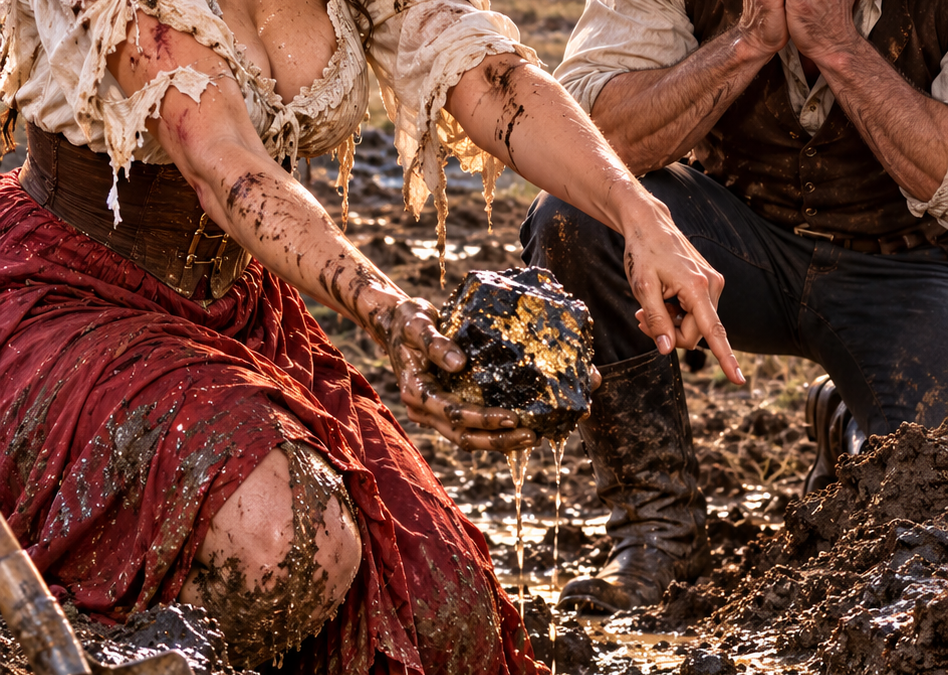
Ruth Ellison was standing barefoot in the mud.
Her skirt was soaked to the knees.
Her hands were filthy.
And scattered around her boots were several strange, dark stones she had dug out of land Caleb had considered worthless for nearly fifteen years.
He frowned.
“What are you doing out here?”
Ruth looked toward the distant ridge.
Then toward the shallow cut she had opened in the earth.
Her face had lost all its color.
“You told me nothing grows here.”
“It doesn’t.”
“You told me this pasture has been dead since your father owned it.”
“It has.”
She swallowed.
“Then explain why the ground underneath it is wet.”
Caleb’s expression changed.
“What?”
Ruth stepped aside.
A thin line of clear water had begun seeping through the soil.
But that wasn’t what made Caleb freeze.
Beside it was something else.
Something hard.
Black.
Heavy.
Something that absolutely should not have been there.
Ruth looked him directly in the eye.
And said the seven words he would remember for the rest of his life.
“Caleb… you’ve been losing money on top of it.”
Six months earlier, he had only wanted a practical wife.
By sundown that day, he would realize he had brought home the one woman capable of changing everything.
The letter had not been romantic.
That was exactly why Ruth answered it.
Widower, thirty-eight. Ranch outside Red Hollow, Wyoming. Requires capable woman accustomed to hard work. Cooking, cleaning, sewing, preserving beef, tending chickens. Separate room provided. Marriage possible if mutually agreeable before winter. No foolish expectations.
Ruth read the final sentence three times.
No foolish expectations.
Good.
She had already buried foolish expectations.
At thirty-two, Ruth Ellison had lost a husband to pneumonia and a baby boy before his second birthday.
After that, she learned not to ask life for tenderness.
Tenderness had a habit of leaving.
Work stayed.
Work made sense.
So when she stepped off the train in Red Hollow with one battered carpetbag, two plain dresses, a sewing tin, and forty-one dollars sewn inside her coat, she wasn’t looking for love.
She was looking for somewhere useful to exist.
Caleb Mercer was waiting beside an old wagon.
He was taller than she expected.
Broad shoulders.
Sun-darkened face.
A scar near his jaw.
His hat looked older than she was.
He gave her a careful glance.
“You Ruth Ellison?”
“Yes.”
“I’m Caleb Mercer.”
“I assumed so.”
He almost smiled.
Almost.
Then he lifted her bag.
“That all you brought?”
“That all you asked me to bring?”
This time he did smile.
Very slightly.
“I think we’ll get along.”
The smile vanished when she saw the ranch.
Mercer Ranch sat fourteen miles north of town.
Or what was left of it did.
The barn leaned to one side.
Three fence lines had collapsed.
Dust covered most of the southern pasture.
The cattle looked thin enough for Ruth to count ribs from fifty yards away.
One windmill stood broken against the horizon.
Another squealed every time the wind shifted.
Caleb watched her face carefully.
“It looked better ten years ago.”
“I’m sure you did too.”
He turned toward her.
Ruth kept walking.
That was the first time she heard him laugh.
It was also the last time for almost a month.
The ranch was failing.
Not slowly.
Not quietly.
It was dying in plain sight.
Three bad summers had burned through pasture.
A winter storm had killed twenty-three head of cattle.
A bank note was coming due in October.
Caleb never told Ruth exactly how much he owed.
She didn’t ask.
But she noticed things.
The unopened envelopes.
The way he counted every sack of grain twice.
The way he watered down stew when hired hands came through.
The fact that he wore boots with cracked soles while a newer pair sat untouched in a catalog beside the stove.
He had not brought her west for companionship.
He needed labor he couldn’t afford to hire.
Ruth understood that immediately.
So she worked.
She scrubbed the kitchen until the pine boards changed color.
She rendered fat.
She salted beef.
She repaired two quilts.
She patched Caleb’s shirts.
She learned how much flour he had left before harvest.
She built shelves in the pantry from discarded packing crates.
When one of the hens stopped laying, she figured out which fox trail led behind the coop.
When a calf grew weak, she sat beside it half the night with warmed milk.
Caleb found her there before sunrise.
“You didn’t have to do that.”
Ruth looked up.
“Yes, I did.”
“Why?”
“Because it was dying.”
Caleb studied her for a long moment.
Then he sat down beside her.
Neither spoke.
That was how most things began between them.
Not with declarations.
With work.
One morning Ruth noticed a strip of grass near the western fence.
Everything around it was yellow.
That strip was green.
Not bright.
But alive.
She mentioned it at breakfast.
Caleb didn’t look up from his coffee.
“Probably runoff.”
“From where?”
“The ridge.”
“There hasn’t been rain in nine days.”
He shrugged.
Ruth stared at him.
“You’ve stopped looking at your own land.”
That made him raise his eyes.
“What’s that supposed to mean?”
“It means you already decided it was dying, so now everything you see proves you right.”
Caleb set down his cup.
“You’ve been here six weeks.”
“Yes.”
“My family has owned this land for forty years.”
“And somehow I’m still the one asking why the grass is green.”
He glared at her.
Ruth buttered her biscuit.
Ten minutes later, Caleb was following her across the pasture.
They found an old irrigation trench almost completely buried beneath weeds.
Farther uphill, they found the remains of a stone-lined channel.
Caleb crouched.
“My father closed this off.”
“Why?”
“Said the spring dried up.”
Ruth walked another fifty yards.
At the base of a limestone shelf, she found damp moss.
“Dead springs don’t usually grow moss.”
Caleb stared at it.
By midday they were digging.
By late afternoon, Caleb’s shirt was soaked with sweat and Ruth’s hands were blistered.
They pulled out roots.
Mud.
Collapsed stones.
A rusted piece of pipe.
Then something shifted.
There was a low sucking sound.
Ruth stepped backward.
Cold water burst through a crack in the earth.
Not much at first.
Then more.
Caleb simply stared.
Water spilled into the old channel.
Ruth laughed.
She couldn’t help it.
Caleb looked at her.
Not the water.
Her.
It was the first time she realized he sometimes forgot to breathe around her.
Within three weeks, the lower pasture changed.
Grass returned.
Two troughs began filling again.
Caleb stopped buying water from a neighboring property.
Then Ruth found a second blocked channel.
After that, the ranch seemed to wake up.
People noticed.
At the general store, old men asked Caleb what miracle he had performed.
He always gave the same answer.
“Wasn’t me.”
By autumn, his cattle were gaining weight.
By first frost, he had enough hay stored to make it through winter.
And somewhere between hauling fence posts, splitting wood, preparing meat, repairing roofs, and sharing coffee before dawn, Caleb began watching Ruth differently.
Not because she was pretty.
Though she was.
Her beauty had never been delicate.
She had strong hands.
A steady gaze.
Dark hair she tied back carelessly.
A face that looked most alive when she was solving a problem.
Caleb noticed something else.
Ruth never asked him to promise her anything.
And that frightened him more than any demand could have.
One night after supper, he found her sitting on the porch wrapped in a blanket.
Snow had begun falling lightly.
He sat beside her.
“You ever think about leaving?”
Ruth looked toward the pasture.
“Sometimes.”
His expression tightened.
She noticed.
“Why?”
“No reason.”
She smiled faintly.
“Poor liar.”
Caleb stared at his hands.
“The reverend comes through Red Hollow next month.”
Ruth said nothing.
“He asked whether I’d made up my mind.”
“And have you?”
Caleb looked at her.
For a second she thought he might finally say it.
Instead, he stood.
“I need to check the barn.”
Ruth watched him go.
“Coward,” she murmured.
She smiled anyway.
Winter passed.
Then came spring.
And spring brought something strange.
One section of the north pasture refused to behave like the rest of the ranch.
The cattle avoided it.
Grass grew in odd patches.
After rain, the soil held moisture longer than it should.
Ruth also noticed something Caleb had never paid attention to.
Certain stones appeared after storms.
Heavy black pieces with reddish streaks.
She brought one into the kitchen.
Caleb glanced at it.
“Rock.”
“That is generally what stones are.”
He gave her a look.
She set it beside the stove.
“What was on that land before your family bought it?”
“Nothing.”
“That’s not an answer.”
“Open range. Some prospectors came through in the seventies.”
“Did they mine?”
“Not successfully.”
Ruth turned the black stone in her hand.
“Where?”
Caleb pointed vaguely north.
“Somewhere past the ridge.”
That was enough.
The next morning, Ruth saddled a mare before sunrise.
She packed water, bread, rope, a small shovel, and the black stone.
By noon she hadn’t returned.
By one, Caleb stopped pretending he wasn’t worried.
By two, he saddled his horse.
He found her nearly three miles north, standing on a ridge overlooking 600 acres he had never bothered to use.
The land was rough.
Rocky.
Mostly scrub.
Worthless for cattle.
Or so everyone believed.
Ruth had removed her shoes and stockings.
Her feet were deep in mud.
Several shallow holes surrounded her.
A pile of black stone sat nearby.
Caleb dismounted.
“You trying to give me a heart attack?”
Ruth barely looked at him.
“Come here.”
“I’ve been looking for you for two hours.”
“Caleb.”
Something in her voice stopped him.
He walked closer.
She pointed toward a patch of exposed ground.
“Dig.”
“What?”
“Dig.”
He took the shovel from her.
A foot down, the earth changed.
Dark soil became coarse gravel.
Then clay.
Then his shovel struck something metallic.
Clang.
Caleb stopped.
He scraped away dirt.
An old iron pipe appeared.
Not ranch pipe.
Much older.
It ran east to west.
Ruth knelt beside it.
“I found three more sections.”
Caleb looked toward the ridge.
“What is this?”
“I don’t know yet.”
She walked twenty feet farther and pointed toward another hole.
Inside were several dark, reddish stones.
“Look at these.”
Caleb picked one up.
Heavy.
Too heavy.
“What am I looking at?”
Ruth took it from him.
“My father worked around mines when I was a girl.”
Caleb looked at her sharply.
“You never told me that.”
“You never asked.”
She handed him another stone.
“He used to bring samples home. Ironstone. Copper-bearing rock. Sometimes coal.”
Caleb stared at what he was holding.
Ruth continued.
“I don’t think this land is worthless.”
His eyes narrowed.
“You think there’s coal?”
“I think someone was looking for something out here.”
She pointed at the old pipe.
“And I think they found enough to build infrastructure.”
Caleb suddenly remembered something.
A story his father used to tell.
Before the Mercers purchased the ranch, an eastern company had leased land in the area.
The project failed.
Or supposedly failed.
Records disappeared.
Workers left.
Then the land sold cheap after a bank collapse.
Caleb had always considered it another useless family story.
Ruth climbed the ridge.
“Come up here.”
He followed.
From the top, the terrain looked different.
A depression curved across the north pasture.
Almost like an old trench.
At the far end stood remnants of rotting timbers half hidden by brush.
Caleb had seen them hundreds of times.
Never wondered why they were there.
Ruth pointed.
“There.”
“What?”
“That line.”
He squinted.
Then he saw it.
The old timbers.
The depression.
The buried pipe.
All of it ran in roughly the same direction.
Toward the hillside.
Caleb went still.
Ruth looked at him.
“There’s something under this land.”
He stepped closer.
“What?”
“I don’t know.”
Her voice was quiet now.
“But I know this much.”
She held up the stone.
“Someone dug here before your family arrived.”
Caleb stared across hundreds of acres he had dismissed since boyhood.
“How did no one know?”
“Maybe someone did.”
He looked at her.
Ruth’s expression darkened.
“Maybe that’s the real question.”
They rode back after sunset.
Caleb barely spoke.
The next morning, he rode into Red Hollow and spent six hours inside the county recorder’s office.
He returned carrying dust-covered copies of deeds, survey maps, and mining claims dating back more than fifty years.
Ruth spread them across the dining table.
One parcel number appeared repeatedly.
North Mercer Section.
A company had filed exploratory claims.
Then withdrawn them six months later.
But something didn’t make sense.
There were no closure records.
No final geological report.
No explanation.
Caleb tapped one page.
“This company disappeared in 1881.”
Ruth looked at the signature.
Then froze.
“What?”
She leaned closer.
The surname at the bottom of the page was familiar.
Ellison.
Caleb looked at her.
“Your name.”
Ruth didn’t answer.
Her father had rarely spoken about his own father.
Only that he had worked “where men dug too deep and lied too easily.”
Ruth swallowed.
“My grandfather’s name was Samuel Ellison.”
Caleb slowly turned the page toward her.
The surveyor listed on the abandoned claim was:
Samuel T. Ellison.
Neither spoke for several seconds.
Caleb finally whispered:
“Your family was here before mine.”
Ruth looked toward the window.
Toward the northern pasture.
And suddenly the whole story changed.
She had believed she came west because of a newspaper advertisement.
Because she needed somewhere to live.
Because a lonely rancher needed someone who knew how to preserve beef.
But now her grandfather’s name was sitting on a forgotten mining document connected to land Caleb’s family had owned for decades.
That afternoon, they returned to the ridge.
This time with picks.
Lanterns.
Rope.
And an old survey map.
They found the entrance just before dusk.
Hidden behind fallen stone and brush was a timbered opening carved directly into the hillside.
An abandoned shaft.
Caleb stared into the darkness.
Ruth’s breathing slowed.
“Your father never told you this was here?”
“No.”
“What about your grandfather?”
“He died before I was born.”
Caleb pulled away part of a rotten board.
Behind it was a metal plate.
Most of the lettering had rusted away.
But two words remained readable.
MERCER-ELLISON
Caleb looked at Ruth.
She looked back at him.
Neither of them smiled.
Because whatever was hidden beneath that dying ranch had never belonged to only one family.
And it had been deliberately buried.
The next morning, Caleb rode to town with samples.
Three days later, a geologist arrived.
Then another.
They walked the north pasture.
They examined the rock.
They entered the old workings.
They measured.
Tested.
Argued quietly.
Finally, one of them sat down at Caleb’s kitchen table.
“You’ve got more than an abandoned mine here.”
Caleb’s throat tightened.
“How much more?”
The geologist looked toward Ruth.
Then back at Caleb.
“If the vein continues beneath the ridge the way we think it does…”
He paused.
“You may be sitting on one of the most valuable deposits discovered in this county in decades.”
Caleb didn’t speak.
Ruth did.
“What kind of deposit?”
The geologist slid the assay report across the table.
Caleb read the first line.
Then the second.
His hands began to shake.
It wasn’t just coal.
It wasn’t simply iron.
The samples contained high-grade copper and silver, with additional indications deeper below the property.
Caleb slowly lowered himself into a chair.
For years he had borrowed money.
Sold cattle.
Skipped meals.
Fought the bank.
Watched his ranch nearly disappear.
And all that time…
he had been standing over something worth potentially more than everything he had ever lost.
But Ruth wasn’t smiling.
Caleb noticed.
“What?”
She looked at the survey records again.
“There’s a problem.”
His stomach dropped.
“What problem?”
She tapped one line.
The original claim contained an inheritance clause.
If commercially viable mineral deposits were ever rediscovered, a portion of the rights reverted to the heirs of the original survey partnership.
Caleb stared at the two names.
Mercer.
Ellison.
Then he looked at Ruth.
She gave a humorless little laugh.
“You wanted a woman who could salt beef.”
Caleb slowly stood.
“And instead?”
Ruth met his eyes.
“You may have mailed for the woman who owns half the mountain.”
For several seconds, neither of them moved.
Then Caleb began laughing.
Not politely.
Not carefully.
He laughed until he had to brace both hands against the table.
Ruth stared at him.
“What is wrong with you?”
He looked up.
“You think I care?”
“You should.”
“Why?”
“Because if this report is right, we’re talking about more money than either of us has ever seen.”
Caleb walked around the table.
“Ruth.”
She stepped back.
“What?”
“You saved the spring.”
Another step.
“You saved the cattle.”
Another.
“You saved this ranch before anyone knew what was underground.”
His voice softened.
“And I was already planning to ask you to stay before we found a single ounce of silver.”
Ruth’s expression changed.
He reached into his pocket.
Her eyes widened.
Caleb placed a small brass ring on the table.
Nothing fancy.
No diamonds.
No silver.
Just a plain ring he had bought in Red Hollow weeks earlier.
“I bought it before you rode north.”
Ruth stared at it.
“You said you were buying fence nails.”
“I bought those too.”
“You terrible liar.”
“I know.”
He swallowed.
“The reverend will be here Sunday.”
Ruth looked at the ring.
Then at the papers.
Then through the window toward the ridge that had changed everything.
But before she could answer…
someone pounded on the front door.
Hard.
Three times.
Caleb turned.
A man from town stood outside holding a telegram.
His face was pale.
“Mr. Mercer?”
“Yes?”
“You need to read this.”
Caleb opened the message.
His expression changed.
Ruth stepped closer.
“What is it?”
He handed her the telegram.
It was from a law office in Cheyenne.
And the first line made her blood run cold.
NOTICE OF COMPETING CLAIM TO NORTH MERCER MINERAL RIGHTS.
Someone else knew.
Someone else had been waiting.
And according to the telegram, that person had documents claiming the mine, the ridge…
and possibly the entire northern half of Caleb’s ranch.
Ruth looked toward the black hills beyond the window.
The discovery beneath the land wasn’t going to save them quietly.
It was about to start a war.
And the name printed at the bottom of the telegram was one Ruth recognized immediately.
A name her father had warned her about when she was a child.
A name she had prayed never to see again.
The name at the bottom of the telegram was Luther Cain.
Ruth read it twice, then a third time, as if the letters might rearrange themselves into something less final. They did not. The paper trembled once in her hand and went still.
Caleb watched her face the way a man watches weather moving in over open ground.
“You know him.”
“I know the name.”
“That’s not the same thing.”
“It is close enough.”
Outside, the man from town shifted his weight on the porch boards. He had not been invited in. He did not seem eager to be. Telegrams of that sort had a way of making a house feel smaller than it was.
Ruth set the paper on the table beside the assay report and the plain brass ring. The three things looked wrong together. A future, a fortune, and a threat, all waiting for someone to decide which one mattered most.
Caleb paid the messenger and shut the door.
For a moment neither of them spoke. The stove ticked. Somewhere in the barn a horse stamped. The ordinary sounds of a ranch that had, until an hour ago, been in the business of surviving winter.
“Tell me,” Caleb said.
Ruth stayed where she was, one hand flat on the table, as if the wood might keep her from going somewhere she did not want to go.
“My father said the name once. I was twelve. We were leaving a boarding house in the middle of the night because a man had been asking for Ellisons at the rail office. My father put me on a wagon with a blanket over my head and told me if I ever heard the name Luther Cain, I was not to answer questions, not to be clever, and not to wait to see what he wanted.”
“And you didn’t ask why.”
“I asked.” Ruth’s mouth tightened. “He said some men dig holes and some men decide who gets buried in them. Then he told me to sleep.”
Caleb picked up the telegram again. The law office in Cheyenne had been polite in the way lawyers were polite when they already believed they had won. Notice of competing claim. Demand to cease disturbance of the north workings. Assertion of prior equitable interest through assignment of the 1879 exploratory lease. A hearing date in Laramie in thirty days. And beneath the firm’s signature, the client: L. Cain, by power recorded in Carbon County, 1882.
Eighteen eighty-two. One year after the Mercer-Ellison plate had been nailed over a shaft and left to rust.
“He waited,” Caleb said.
“Or someone told him we stopped waiting.”
They both looked toward the window. The ridge was only a dark line now, but it felt nearer than it had at noon.
Caleb reached for the ring, then stopped. His hand hovered and dropped.
“Sunday can wait.”
“Don’t do that.”
“Do what?”
“Decide for me what I’m afraid of.” Ruth turned the telegram over, though the back was blank. “If you bought that ring before you knew about the silver, then the silver doesn’t get to unbuy it. And if Cain thinks a piece of paper from Cheyenne makes me pack my carpetbag, he has not met the woman who dug your spring out of the mud.”
Something in Caleb’s face eased and sharpened at the same time.
“You always talk like the fight’s already yours.”
“It isn’t.” She met his eyes. “But I am not leaving it on the table next to a ring and calling that romance.”
He almost smiled. It did not last.
“Then we go to town at first light,” he said. “Recorder’s office. Bank. Anyone old enough to remember a company that was supposed to have failed.”
“And tonight?”
Caleb glanced at the rifle above the door, then at her.
“Tonight we sleep in shifts. If a man has waited forty years, he will not mind waiting until morning. I mind.”
They did not sleep much.
Ruth took the first watch from the kitchen window, the assay papers spread under the lamp, the old survey map pinned by a tin cup. She traced the abandoned claim with a pencil until the line of it sat in her bones: ridge, depression, buried pipe, timbered mouth. Mercer-Ellison. A partnership struck into metal and then buried like a shame.
Her grandfather had been a surveyor, not a gunman. That was what her father had allowed. Samuel T. Ellison drew lines other men got rich crossing. He had a steady hand and a bad habit of believing a signature meant what it said. Somewhere between a limestone shelf in Wyoming and a boarding house in the dark, that habit had gotten him killed, or close enough to killed that his son would not say the difference out loud.
At midnight Caleb came in with cold on his coat. He set a cup beside her and did not ask her to stop reading.
“Find anything we didn’t already know?”
“Only that they withdrew the claim six months after filing it, and nobody filed a final report.” She tapped the copy. “You don’t abandon a hole quietly if the hole is empty. Empty is easy to explain. Empty gets written down.”
“So they found it.”
“They found enough to frighten somebody.” Ruth looked up. “Or enough to be worth lying about.”
Caleb stood behind her chair. He did not touch her. The not-touching had a weight of its own.
“If the inheritance clause is real,” he said, “half of whatever is down there was always yours. Cain can paper the county until his ink runs dry. He can’t make your grandfather unsign his name.”
“He can make a court believe the signature was sold.” She folded the map. “Men like that don’t come for half. They come to say there was never a half.”
Before dawn they rode.
Red Hollow was barely awake. Smoke stood up from chimneys in thin gray ropes. The recorder’s office smelled of dust and coal oil and the particular patience of ledgers that had outlived the men who wrote in them. The clerk, a narrow woman with ink on her cuff, listened to Caleb and then to Ruth and then, interestingly, looked longer at Ruth.
“Ellison,” she said. “Not a common request.”
“It wasn’t a common survey,” Ruth said.
The clerk brought a box that had not been opened in years. Inside were brittle copies, a torn plat, and a note in a different hand pinned to the withdrawn claim: See Cain correspondence, transferred to private holding, 1882. No copies retained.
Caleb swore under his breath.
“Who authorized the transfer?”
“Someone who didn’t leave a name they’d like read aloud.” The clerk hesitated. “There’s an old man at the end of Railroad Street. Otis Briggs. He kept books for the land company before it folded. If he isn’t dead, he remembers spite better than most people remember Christmas.”
Otis Briggs was not dead. He was on a porch that leaned worse than Caleb’s barn, wrapped in a quilt, watching the road as if it owed him an apology. His eyes were milk at the edges and sharp at the center.
He listened. When Ruth said Samuel Ellison, the sharpness won.
“Sam Ellison drew a true line,” Briggs said. “That was his trouble. True lines make liars nervous.”
“Did he find copper?” Caleb asked.
“He found a reason the company stopped sending cheerful letters.” Briggs coughed into the quilt. “Three men died in that hill. Not in a newspaper way. In a covered way. Cave-in, they called it, after the families had been paid to call it something else. Sam wouldn’t sign the quiet report. Said the timbers were cut cheap and the order to pull them came from a man who wasn’t in the hole when it fell.”
Ruth’s hands had gone cold inside her gloves.
“Luther Cain.”
“Aye.” Briggs looked at her as if measuring what the name cost. “Cain was the money’s nephew, or its cousin, or its favorite knife. Hard to tell with eastern money. He wanted the claim quiet, the bodies quieter, and the lease assigned to a company that didn’t exist long enough to be sued. Your grandfather wouldn’t assign. So Cain found a way to say he had.”
“A forgery,” Caleb said.
“A frightened clerk and a notary who liked whiskey.” Briggs shrugged, and the quilt slipped. “The Mercers bought the surface cheap after the bank scare. Your grandfather, miss, got a train ticket and a warning. I heard he took the ticket. I heard he did not outrun the warning by much.”
Ruth heard her own pulse in her ears.
“Is the assignment still in the county?”
“Not in any drawer I was allowed to open.” Briggs leaned forward. His voice dropped. “But Sam Ellison was not a fool at the end. He mailed a packet east to his son before he boarded. Copies. Dates. The names of the three men. If that packet lived, Cain doesn’t own the mountain. He owns a story.”
The ride back was longer than the ride in. Wind came down off the ridge and worried the horses’ manes. Caleb did not fill the silence with comfort he had not earned. Ruth was grateful for that, and angry that she was grateful, and too tired to sort the difference.
At the ranch gate a buggy stood where no buggy should have been.
A man in a city coat waited beside it, hat in his hands, as polite as a blade laid on a table. He was younger than Cain would have been. Thirty, perhaps. Smooth face, careful smile, boots too clean for October mud.
“Mr. Mercer,” he said. “Miss Ellison. My name is Stephen Wade. I represent Mr. Cain’s interests in the territory. I was hoping we might speak before this becomes unpleasant.”
Caleb did not dismount.
“It’s already unpleasant.”
Wade’s smile did not move. “Then perhaps we can keep it from becoming fatal. Mr. Cain has no wish to drag a widow through a hearing. He is prepared to purchase your surface concern at a fair price and to settle any sentimental claim Miss Ellison believes she inherited. In exchange, you cease excavation, surrender the assay samples, and sign a quitclaim.”
Ruth swung down. Mud took her hem. She did not care.
“Sentimental,” she said.
“Family stories often are.”
“My grandfather’s name is on a plate bolted over that shaft. Is that sentiment?”
Wade glanced at the ridge, then back, and for the first time the smile thinned. “Plates rust. Assignments do not. Mr. Cain holds the surviving instrument. You hold a hope and a hole in the ground. Holes collapse.”
Caleb was off his horse now. He did not raise his voice. That made it worse.
“You tell your man the north pasture is not for sale. You tell him if he sends another clerk to my door, he can come himself and say the word collapse where I can hear it.”
“He intends to.” Wade set his hat back on his head. “He boards the train at Cheyenne tomorrow. He asked me to give Miss Ellison a message, in the event she was as stubborn as her blood.”
Ruth waited.
Wade delivered it lightly, as if it were a courtesy.
“He said the packet your father kept was burned in a St. Louis rooming house in ’ninety-one. He said he watched the ashes. And he said if you go into that hill again before the hearing, he will not bother with Laramie. He will bury the argument where the first one was buried.”
He touched his hat, climbed into the buggy, and left them in the ruts.
Caleb’s jaw worked. “We take the samples to a second assayer. We hire a lawyer in Laramie. We do not give him the satisfaction of a dark hole.”
Ruth was already walking toward the barn.
“Ruth.”
“He said the packet burned.” She pulled the latch. “My father never kept paper in a rooming house. He sewed it into a coat lining and made me wear the coat when we ran. I sold every dress I owned before I came west. I did not sell the coat.”
Caleb stared at her.
“It’s in the carpetbag,” she said. “I thought it was nothing. Old stitching. A habit. I haven’t cut the seam since I was sixteen.”
They cut it at the kitchen table with the lamp turned high and the door barred.
The packet was thin, oil-dark at the edges, still bound with surveyor’s twine. Samuel Ellison’s hand was narrow and exact. There were dates. There was a list of three names: Hobart, Pellegrini, Young. There was a copy of a refusal to assign the lease. There was a note in a shaking addition: Cain ordered the lower stope pulled while men were still timbering. If I do not leave the territory, look for me at the north adit. I have left the true plat where only an Ellison would think to measure.
Ruth’s eyes stung. She blinked hard and did not wipe them.
“He was still alive when he wrote that.”
“And he thought someone would come back,” Caleb said.
They looked at each other across the ruined seam of an old coat. The ring was still on the table. Neither of them touched it. There would be time for rings if there was time for anything.
“Where would an Ellison measure?” Caleb asked.
Ruth heard her father’s voice, not the warning this time, but the earlier one, the one he used when he taught her to read a map by a bad lamp. Start from the mark they want you to see. Then count backward.
“The plate,” she said. “Mercer-Ellison. Everyone looks at the words. A surveyor looks at the nails.”
They went at dusk, because waiting for morning felt like agreeing with Wade. Lanterns. Rope. The packet wrapped in canvas inside Caleb’s coat. The rifle. Ruth’s small shovel. The wind had dropped, which made the hillside louder: a tick of stone, the dry talk of brush, their own breath.
The timbered mouth was as they had left it, half-choked with fallen rock. The metal plate hung crooked where Caleb had pulled the board away. Four nails. Three ordinary. The fourth, lower left, sat a finger’s width off the pattern.
Caleb worked it loose.
Behind it, folded small enough to hide in a tobacco tin, was a second plat. Not the county’s. Samuel’s. The vein drawn true. And a mark in the lower stope, circled twice, with one word beside it.
Proof.
The shaft took them in a cold breath. Timbers groaned like old men turning over. Ruth kept one hand on the wall. The lantern threw their shadows long and then ate them. Forty feet down, the passage bent. The air changed. Wetter. Older. Caleb stopped so suddenly she nearly walked into his back.
“Don’t,” he said.
She looked past his arm.
The lower stope had not collapsed cleanly. Someone had built a crib of stone and timber across it, hasty, meant to look like ruin if a casual lamp passed by. Caleb set the lantern on a ledge and pulled one beam. The crib sighed and gave.
Behind it was a chamber no wider than a wagon bed. Pick marks. A vein of dark rock shot with green and dull silver, richer than the samples on the kitchen table. And against the far wall, wrapped in what had once been a coat, three shapes that were not stone.
Ruth made a sound she did not recognize.
Caleb stepped in front of her, then seemed to remember she had not asked to be spared. He moved aside. The lantern shook in his hand and steadied.
Hobart. Pellegrini. Young. Or what the hill had left of them. A belt buckle. A boot with a maker’s mark. A survey tag still tied to a button, the ink surviving where flesh had not: S.T.E. — hold for county.
Samuel had tagged his dead so they could not be called a story.
“Cain will say grave robbers,” Caleb said quietly. “He will say we planted this.”
“Then we don’t move them tonight.” Ruth’s voice was thin and exact, which was the only way she could keep it. “We mark the chamber. We copy the tag. We get Briggs to swear while he still can. And we get this plat to a lawyer who isn’t afraid of a train from Cheyenne.”
A pebble clicked somewhere above them.
Not the settling kind.
Caleb killed the lantern.
Darkness came down like a lid. Ruth felt his hand find her wrist, two fingers, a signal: still. They stood in the mineral smell and the silence, and then the silence broke into a boot on timber. One man. Then another. A match flared far up the adit and died.
Wade’s voice carried, pleasant as it had been in the yard.
“Mr. Cain prefers not to wait on Laramie after all. He said if the granddaughter was anything like the surveyor, she would come looking for a nail.”
Light grew. Two lamps. Wade, and behind him a heavier man with a city coat over trail dirt and a face Ruth had only ever imagined as a warning. Older. Pale eyes. A mouth that had practiced patience the way other men practiced knives.
Luther Cain looked at the opened crib, at the vein, at the tagged dead, and finally at Ruth.
“You have your grandfather’s inconvenience,” he said. “I had hoped the coat burned with the rest of him.”
Caleb raised the rifle. The heavier man did not reach for his own. He only smiled, small and tired.
“Shoot me in my own hole,” Cain said, “and the hearing becomes a hanging. Lower it, Mercer. We’re going to walk out and discuss what an Ellison signature is worth when the Ellison is standing in the room.”
Ruth felt the plat against Caleb’s ribs where their arms touched. Proof, circled twice. Three names. A refusal. A nail pulled out of true.
Above them, more boots entered the adit. Not two men. Four. The hill took the sound and brought it back wrong, so she could not tell whether the new steps were coming down toward the stope or sealing the timbered mouth behind them.
Cain tilted his head, listening, and the smile left him.
“Those,” he said softly, “are not mine.”
The lanterns flickered. Somewhere between the living and the tagged dead, a board dropped across the passage, and the dark started to learn their names.